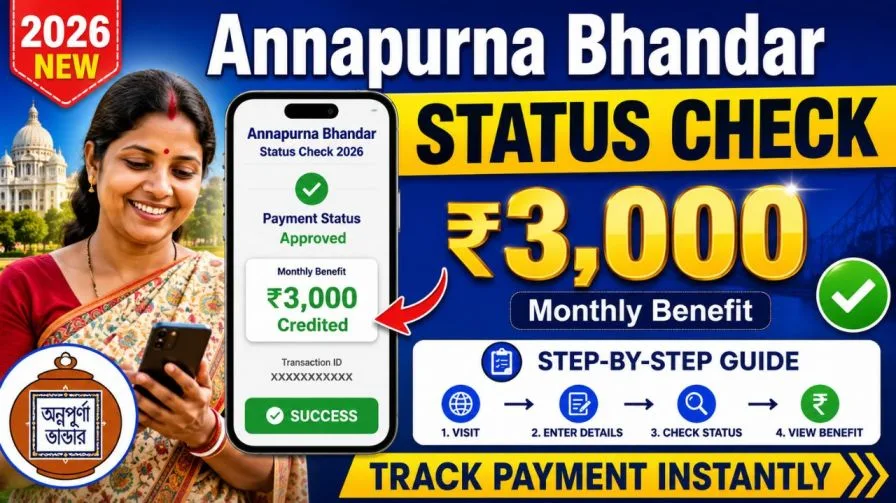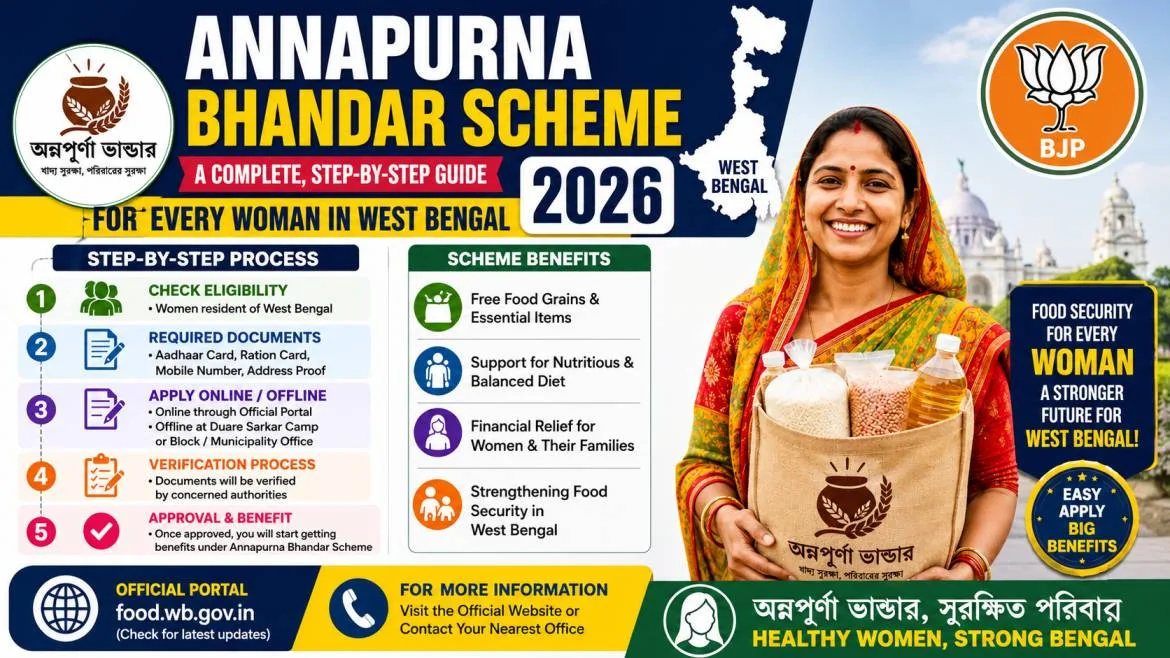
In 2026 the BJP set out to reshape West Bengal’s welfare canvas. At the centre of its campaign was a single, powerful promise: ₹3,000 every month for the women of the state, delivered through a brand‑new scheme called Annapurna Bhandar (also referred to as Annapurna Yojana or Maa Annapurna’s Bhandar). This flagship pledge, positioned as a direct counter to the Trinamool Congress’s Lakshmir Bhandar, is now moving from manifesto paper to government machinery. This article breaks down everything we know so far – the payment structure, eligibility criteria, documents required, application steps, status‑checking methods, important dates, and critical conditions – all in one place, so you can prepare before the official portal opens.
What is Annapurna Bhandar?
Annapurna Bhandar is a proposed direct‑benefit‑transfer (DBT) scheme designed to provide unconditional monthly cash assistance to women in West Bengal. The BJP pitched it as a higher‑value alternative to the existing Lakshmir Bhandar programme, which offered ₹1,500 (General) and ₹1,700 (SC/ST) per month but has now been suspended.
The scheme’s stated goals are:
- To make women financially self‑reliant.
- To help families cover daily household expenses.
- To extend direct support to women from lower‑ and middle‑income households.
- To disburse funds directly into Aadhaar‑linked bank accounts via DBT.
The name Annapurna – the goddess of food and nourishment – signals the government’s intent to position the scheme as a tool for strengthening household nutrition and stability.
Key Highlights & Payment Structure
| Feature | Details |
|---|---|
| Monthly payout | ₹3,000 per eligible woman |
| Annual payout | ₹36,000 per beneficiary |
| Mode of transfer | Direct Benefit Transfer (DBT) to the applicant’s Aadhaar‑linked bank account |
| Overseeing department | Likely the State Women & Child Development or Finance Department (to be confirmed) |
| Official portal | Not yet live; a dedicated website is expected |
| Political context | Replaces the suspended Lakshmir Bhandar scheme |
Why ₹3,000? During the campaign, senior BJP leaders – including state president Samik Bhattacharya and Assam CM Himanta Biswa Sarma – repeatedly emphasised that the ₹3,000 figure was chosen to “double” what women were receiving earlier, thereby signalling a step‑change in welfare delivery.
Eligibility Criteria (Who Can Apply?)
Though formal guidelines have not been gazetted, the following eligibility conditions have been consistently cited by party spokespersons and are widely expected to form the backbone of the scheme:
- Residency: The applicant must be a permanent resident of West Bengal.
- Gender: The scheme is exclusively for women.
- Age: The minimum age is likely to be 25 years. (An upper age cap has not been specified in most announcements, though some sources suggest up to 60 years may mirror the earlier scheme.)
- Bank Account: The woman must hold a savings bank account in her own name, and that account must be linked to her Aadhaar number for DBT.
- Employment Status: Women who are regular government employees (state or central) are not eligible. However, informal workers, homemakers, and casual labourers are expected to qualify.
- Income Ceiling: While some reports mention an annual family income limit (possibly around ₹1.5 lakh), this has not been officially confirmed. Applicants should wait for the final notification.
Plain‑English Checklist: You are likely eligible if you are (a) a woman, (b) aged 25 or above, (c) a permanent resident of West Bengal, (d) not a government employee, and (e) have an Aadhaar‑seeded bank account.
Documents Required
Keep the following documents ready – both original and self‑attested photocopies:
- Aadhaar Card (mandatory for identity and DBT linkage)
- Voter ID Card (EPIC) – proof of West Bengal residency
- Bank Passbook (first page showing account number and IFSC code)
- Passport‑size colour photograph (recent, white background)
- Active mobile number (linked to Aadhaar for OTP verification)
- Caste Certificate (if claiming SC/ST benefit, should a reserved category provision be introduced)
- Income Certificate (if income criteria are imposed)
- Ration Card (may be asked as supplementary proof of family composition)
Pro tip: Ensure that the name on your Aadhaar, bank passbook, and voter ID matches exactly. Discrepancies can lead to rejection.
How to Apply (Online & Offline)
The application process has not yet officially begun, but available information points to two possible channels:
✅ Online Application (Expected Steps)
- Visit the official website – once the government announces the dedicated portal.
- Register using your mobile number.
- Verify the OTP sent to your mobile.
- Fill in the application form with personal details (name, address, age, bank information, etc.).
- Upload scanned copies of the required documents.
- Preview the form, then click “Submit” .
- Note down the application reference number that appears on screen.
✅ Offline Application
- Forms are already being distributed at BJP party offices and community camps in several districts, although these are “guarantee cards” or preliminary registration slips.
- Once the scheme is formally notified, applicants will likely be able to collect and submit the official form at designated government camps, block offices, or municipality wards.
- Fill in the form, attach documents, and submit it to the designated officer. Obtain an acknowledgement receipt.
Important: The BJP’s “Matrishakti Bharosa Card” being circulated is not the final application. It is a campaign‑era promise card. Wait for the official government notification before submitting sensitive documents.
How to Check Application Status
After applying, you can track your application status as follows:
- Go to the official Annapurna Bhandar portal (when live).
- Click on the “Check Application Status” or “Track Application” tab.
- Enter your Application Reference Number or registered mobile number.
- The current status (e.g., “Submitted”, “Under Review”, “Approved”, “Rejected”) will be displayed.
You can also expect status updates via SMS if your mobile number is registered.
Important Dates & Launch Timeline
The timeline is still evolving, but key milestones are clear:
- 9 May 2026: Swearing‑in ceremony of the new BJP government in West Bengal.
- May 2026 (end) – June 2026 (first week): The scheme is expected to be officially launched and the application window opened.
- First instalment: Likely to be credited one to two months after government formation and verification of the first batch of beneficiaries.
Current status: As of the date of writing, the scheme has not yet been notified in the official gazette. Any form collection or registration before the official announcement is unofficial.
Frequently Asked Questions (FAQs)
Q1. Is Annapurna Bhandar a confirmed government scheme?
A. It was a manifesto promise of the BJP and is expected to be implemented after the swearing‑in of the new government. However, it has not yet been gazetted.
Q2. What happens to the Lakshmir Bhandar scheme?
A. The Lakshmir Bhandar scheme has been suspended, and beneficiaries have not received payments for May 2026. Annapurna Bhandar is intended as its replacement.
Q3. Do I need to fill the “guarantee card” being distributed by BJP workers?
A. Those cards are pre‑election campaign tools. They do not constitute an official application. Wait for the government‑issued application form.
Q4. Will the money be given to all women regardless of income?
A. This is not yet confirmed. Early indications suggest an income ceiling may be applied, but only the official notification will provide clarity.
Q5. Can I apply if I already receive a widow pension or old‑age pension?
A. Likely yes, as long as you meet the primary eligibility criteria. However, government employees are excluded.
Conclusion
The Annapurna Bhandar scheme carries the potential to become one of the largest women‑centric cash‑transfer programmes in West Bengal. With a promised monthly payout of ₹3,000, it would double the financial assistance that millions of women had received under the earlier regime. As the new BJP government settles in, all eyes are on the official notification that will turn a campaign promise into a live welfare programme. Until then, the best course of action is to check your eligibility, gather your documents, and stay tuned to official channels.